

Helical Pile Underpinning
A modern, low-disruption solution to stabilise and support existing buildings affected by subsidence.
 Open full size
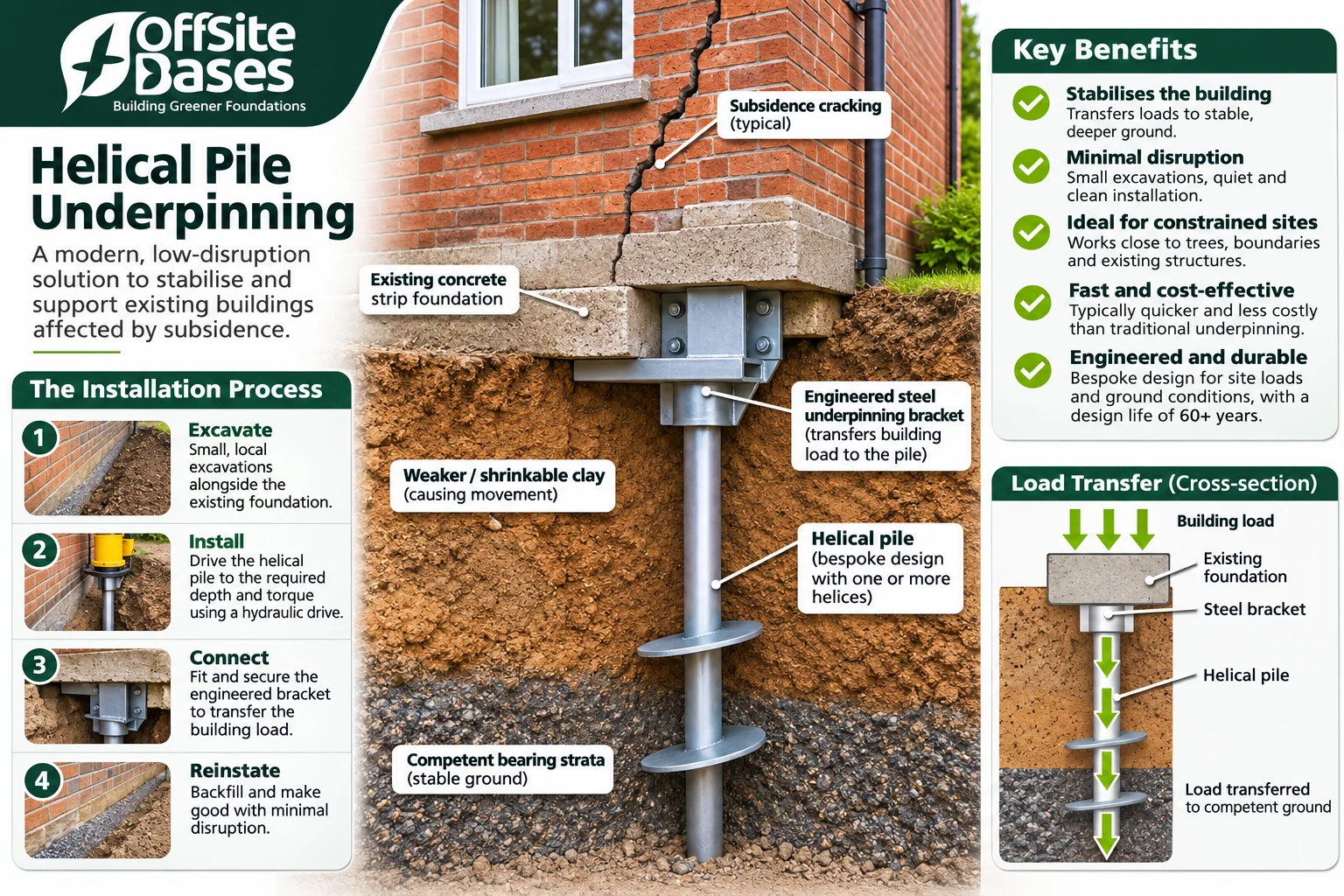
Helical Pile Underpinning — A modern, low-disruption solution to stabilise and support existing buildings affected by subsidence.
The Installation Process
- Excavate — Small, local excavations alongside the existing foundation.
- Install — Drive the helical pile to the required depth and torque using a hydraulic drive.
- Connect — Fit and secure the engineered bracket to transfer the building load.
- Reinstate — Backfill and make good with minimal disruption.
Labels
- Subsidence cracking (typical)
- Existing concrete strip foundation
- Weaker / shrinkable clay (causing movement)
- Engineered steel underpinning bracket (transfers building load to the pile)
- Helical pile (bespoke design with one or more helices)
- Competent bearing strata (stable ground)
Key Benefits
- Stabilises the building — Transfers loads to stable, deeper ground.
- Minimal disruption — Small excavations, quiet and clean installation.
- Ideal for constrained sites — Works close to trees, boundaries and existing structures.
- Fast and cost-effective — Typically quicker and less costly than traditional underpinning.
- Engineered and durable — Bespoke design for site loads and ground conditions, with a design life of 60+ years.
Load Transfer (Cross-section)
- Building load
- Existing foundation
- Steel bracket
- Helical pile
- Load transferred to competent ground
Discuss your project
Send us your drawings or speak to our team about your site and foundation requirements.